



Little Spain Returns to New York’s Map More Than a Century Later
New York City unveiled a new honorary street sign Monday at the corner of West 14th Street and Eighth Avenue in Manhattan, called «Little Spain–La Nacional Way,» honoring the historic enclave of Spanish immigrants that flourished in that area during the twentieth century. The sign joins other ethnic neighborhoods on the city’s map and represents a long-overdue recognition of the vibrant Spanish community that shaped the neighborhood for over 150 years.

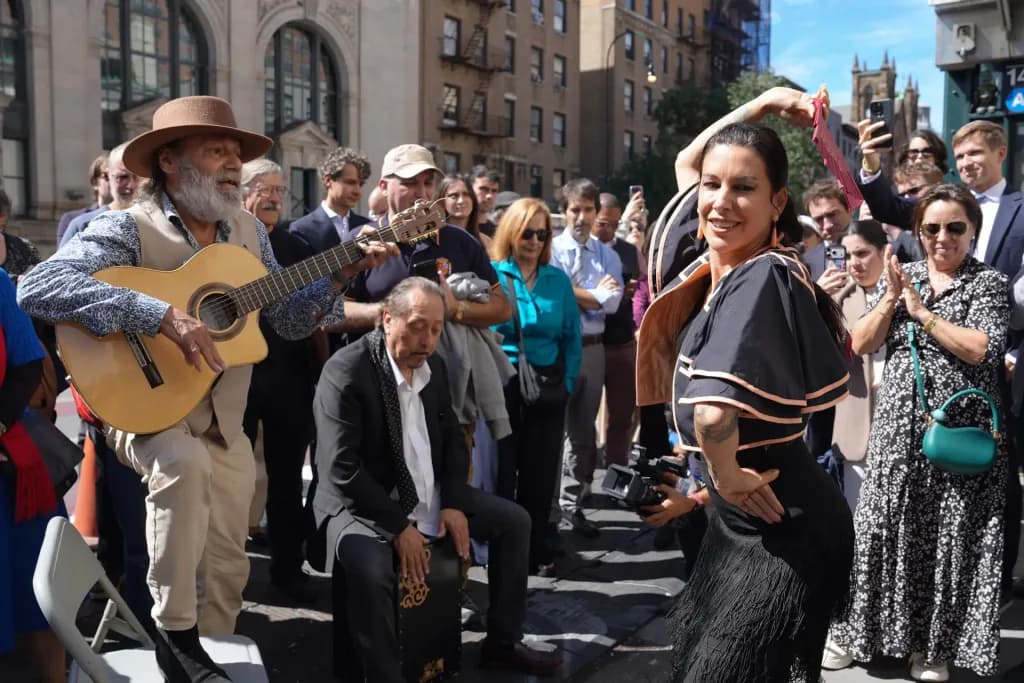
The city of New York unveiled a new honorary street sign Monday at the corner of West 14th Street and Eighth Avenue in Manhattan. The sign, called «Little Spain–La Nacional Way,» honors the historic enclave of Spanish immigrants that flourished in that area during the twentieth century.
The designation coexists with the official name of West 14th Street and does not replace it. New York thus adds this corridor to its map of ethnic neighborhoods, alongside Little Dominican Republic, Little Italy, Chinatown, and Koreatown.
Since 1868: The Origins of La Nacional
The history of the enclave begins in 1868, with the founding of La Nacional–Sociedad Benévola Española. The institution was established to assist Spanish immigrants arriving in the city in search of opportunities. Over time it became a space to preserve the language, gastronomy, and traditions of newcomers.
Since 1925, La Nacional has had its headquarters at 239 West 14th Street. Around the building grew a community of restaurants, shops, and social clubs. That stretch, between Seventh and Eighth Avenues, became known as Calle Catorce or Little Spain.
Businesses like La Bilbaína, Café Madrid, Bar Coruña, Mesón Flamenco, Casa Moneo, and El Faro operated there. Another central point was the Church of Our Lady of Guadalupe, founded in 1902 for the growing Spanish-speaking population. Today, 157 years after its founding, La Nacional continues to function as a cultural and community anchor for the Hispanic community in the area.
A Years-Long Process With Community Support
The sign is the result of several years of efforts with municipal authorities. Manhattan Community Board 4 (MCB4) approved the initiative on January 7, 2026. The vote was 44 in favor, none against, and no abstentions.
This type of honorary designation follows a formal process in New York. A city council member submits the request, the community board of the district evaluates it, and if approved, the Department of Transportation (DOT) installs the sign on the corresponding pole.
With support from the Spanish Embassy in Washington, La Nacional gathered 329 letters of support signed by the community. The area where the sign is located, at the intersection of the Meatpacking, Chelsea, and Greenwich Village neighborhoods, still preserves traces of that Spanish past, visible on the facade of the building where the Spanish and American flags wave.
Voices Reclaiming the Neighborhood’s Memory
«This place does not represent a new history. It is a history that has become visible after more than a century,» said Michelle Mirón, spokesperson for La Nacional, during the ceremony. The event took place during Hispanic Heritage Month.
A city council member who championed the initiative also participated in the event. He highlighted that the Spanish community joins the long list of immigrant communities that have made their home on the west side of Manhattan throughout the city’s history.
For James D. Fernández, a researcher of Spanish immigration and professor at New York University, the sign is an act of historical justice. «We are honoring the quiet and decent lives of thousands of women and men who transformed this part of the city,» he stated.
From Camprubí to Goya: Faces of a Community
Fernández noted that memory of Spanish presence in America often focuses on conquistadors and explorers. This leaves in the background the workers who emigrated later of their own accord. In New York, those immigrants worked as tobacco workers, miners, bricklayers, and cooks.
Among the notable residents of Little Spain were José Camprubí, owner of the newspaper Diario La Prensa, and Emilio Núñez, the city’s first Hispanic judge. Both also served as presidents of La Nacional at different points in its history. The Bustelo and Unanue families also stood out, whose neighborhood businesses became the food brands Café Bustelo and Goya.
Fernández’s own history is linked to the institution. In 1920, at a party organized by La Nacional, his grandparents, Carmen Alonso and José Fernández, met. «Thanks to that party they fell in love, got married, and started a family. I owe my life to La Nacional,» he recounted.
Max Vázquez, vice president of La Nacional and a member for 75 years, also attended the ceremony. He recalled the vibrant neighborhood where he grew up, marked by a very united Spanish community that frequently formed families with Latin American neighbors. The event included a flamenco performance before the official unveiling of the sign.
La Nacional continues to be active today through art, gastronomy, music, and community activities open to the public. Those wishing to learn about this history can visit its headquarters at 239 W. 14th Street, which combines a restaurant and cultural space. The sign, its promoters said, seeks to make that legacy visible for future generations.
Canal oficial
Únete a nuestro canal de WhatsApp
Recibe las noticias más importantes al instante, sin spam. Solo lo que importa, cuando importa.
Etiquetas

Comentarios
Inicia sesión para comentar
Es gratis y toma un minuto. Con tu cuenta también podés:
- Comentar y participar en la conversación
- Guardar notas para leer después
- Ver tu historial de lectura
- Recibir el boletín con tus temas favoritos