



Trump Sets 50% Tariff on Canadian Imports
President Donald Trump signed an executive order Monday imposing a 50% tariff on most products imported from Canada, effective in thirty days, while exempting strategic sectors like energy, potash, and critical minerals. The move represents an escalation in trade tensions and drew an immediate response from Canadian Prime Minister Mark Carney, who accused the U.S. of violating the USMCA trade agreement.

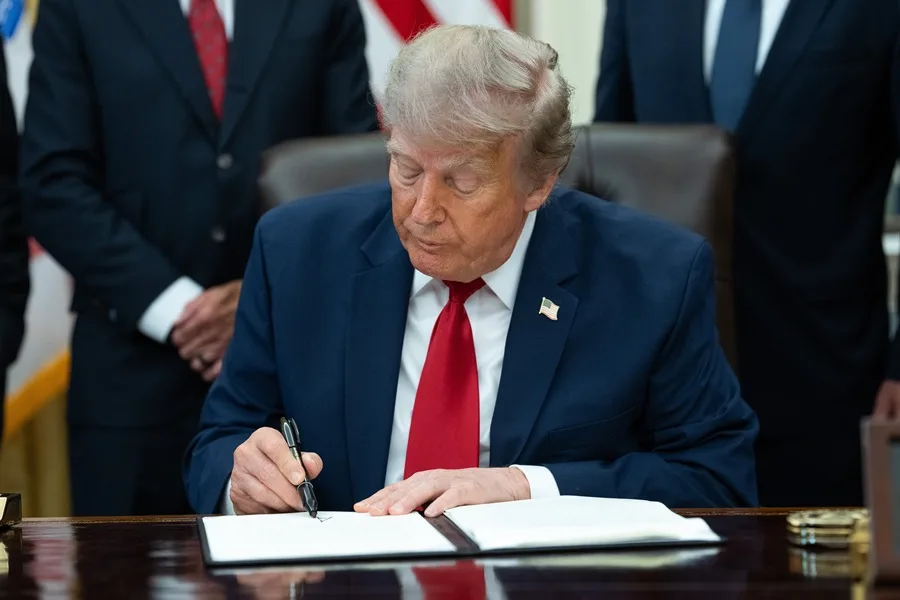
U.S. President Donald Trump signed an executive order Monday with major trade implications. The measure imposes a 50% tariff on most products imported from Canada. This new provision will take effect within thirty days, according to the official document. The measure excludes some sectors considered strategic for the U.S. economy. Among the exempt products are energy, potash, critical minerals, and fish. However, the tariff does apply to other goods previously protected by USMCA.
A new blow to bilateral trade
This additional tax follows the tariff regime in place since last February. At that time, Trump had imposed a general 10% levy on Canadian imports. That measure came after U.S. courts suspended tariffs implemented under emergency laws. The new executive order thus represents a considerable escalation in the trade dispute. The decision came just days after Trump publicly threatened Canada for a completely different reason.
Trump’s accusations over forest fires
Last Friday, through his Truth Social account, Trump warned of possible new tariffs. The threat was related to wildfire smoke that affected the northern and eastern United States. The Republican president accused the Canadian government of not properly managing its forests. He argued that smoke from those fires deteriorated air quality in U.S. territory, at a cost he described as «incalculable.» This summer’s forest fires in Manitoba, Saskatchewan, and Ontario generated extensive smoke columns. These reached several northern U.S. states, triggering health alerts in various cities.
The White House’s official justification
However, the White House justified the new tariff measure with arguments different from the forest fires. It stated that Canada maintains trade practices it considers «harmful» to the United States. Among these practices, the U.S. government mentioned restrictions on access to U.S. dairy products. It also cited high tariffs on certain agricultural goods and taxes on digital services. The White House added that Canada has retaliated with counter-measures to previous trade measures adopted by Washington. This argument served as the main basis for justifying the new tariff escalation.
Stricter sanctions against transshipment of goods
The new text also toughens sanctions against tariff evasion practices. Specifically, it refers to transshipment of merchandise through third countries. According to the executive order, goods diverted to avoid paying the levy will face additional consequences. These products will be subject to an extra 40% tariff on their original value. This provision aims to close possible legal loopholes that would allow companies to avoid paying the new trade tax.
Canada responds and accuses USMCA violation
Canada’s Prime Minister Mark Carney reacted immediately to the U.S. announcement. He accused the United States of directly violating the Treaty between Mexico, the United States, and Canada. «This is the latest in a series of unilateral trade actions by the United States,» Carney stated in an official statement. The Prime Minister added that tariffs on Canada’s automotive sector also violate the current treaty. Carney argued that his country has only «matched those measures» in response to Washington’s prior actions.
Canada proposes modernizing the trade agreement
The Canadian Prime Minister assured that his government has presented detailed proposals to resolve the current dispute. These initiatives also seek to modernize the trade agreement itself, known as CUSMA. «We are prepared to intensify those conversations in the coming weeks,» Carney declared in his statement. The Prime Minister showed willingness to continue negotiating with the U.S. administration.
At the same time, he firmly defended the benefits of free trade for both economies involved in the dispute.
Warning about economic impact on both countries
Carney warned that this trade dispute has considerably raised costs for families. According to the Prime Minister, this effect is especially felt among U.S. consumers. The Prime Minister concluded by reaffirming his country’s commitment to protecting local workers and businesses. He assured that Canada will continue taking necessary measures to safeguard its farmers and families. Despite the tension generated by the new tariff, Carney reiterated his government’s willingness to negotiate with Washington. The objective, he noted, is to reach a solution that benefits both nations in the medium term.
A trade conflict that continues to escalate
The imposition of this new tariff represents one of the most tense episodes in the trade relationship between both countries. The measure directly affects thousands of companies that depend on bilateral trade.
Economic analysts warn that this escalation could generate significant consequences for different productive sectors. Both consumers and businesses are at risk.
Canal oficial
Únete a nuestro canal de WhatsApp
Recibe las noticias más importantes al instante, sin spam. Solo lo que importa, cuando importa.

Comentarios
Inicia sesión para comentar
Es gratis y toma un minuto. Con tu cuenta también podés:
- Comentar y participar en la conversación
- Guardar notas para leer después
- Ver tu historial de lectura
- Recibir el boletín con tus temas favoritos