



Trump Launches Threat at Press on Air Force One
Tensions between the United States and Iran escalated this week as President Donald Trump engaged in a tense exchange with journalists aboard Air Force One, warning that they could also die if Tehran attacked the presidential aircraft. The incident occurred after takeoff from Ankara, Turkey, following Trump’s participation in the NATO summit.

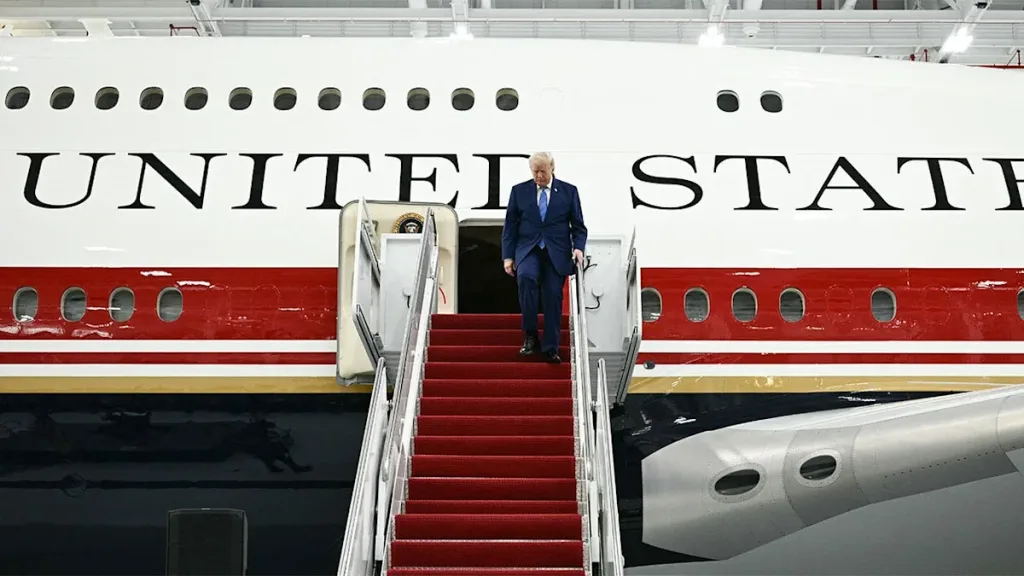
Tensions between the United States and Iran escalated again this week. President Donald Trump engaged in a tense exchange with journalists aboard the Air Force One. He warned that they too could die if Tehran decided to attack the presidential aircraft.
The episode occurred after takeoff from Ankara, Turkey, where Trump participated in the NATO summit. A reporter asked him about the risk of an Iranian attack on the presidential plane. The president’s response left the entourage in absolute silence.
«If I go, you go too»: the phrase that sparked controversy
Trump responded that he faces a constant threat and described himself as Iran’s number one target. He then launched the warning that became news within minutes: «But if I go, you go too.»
The comment didn’t end there. The president suggested that some journalists might want to consider changing professions. Several media outlets noted that the phrase was directed specifically at a reporter who persisted with questions about credible threats.
The statement came in an extremely delicate context. The United States had launched more than 80 retaliatory strikes against Iranian targets following attacks on commercial vessels in the Strait of Hormuz. Iran responded by attacking U.S. military assets in Kuwait and Bahrain, which escalated fears of a major escalation.
The mysterious plane switch that fueled suspicions
Hours before the impromptu press conference, an unexpected logistical turn occurred. Trump left Ankara using the traditional Air Force One, instead of the new luxury aircraft donated by Qatar.
The classic aircraft retains defense systems and redundancies that security officials are unwilling to abandon during moments of real threat. Sources indicated that Trump was transferred to the older aircraft for the first leg of the flight because of its superior safety features, at a time when his security was considered an urgent matter.
During the journey to England, the crew temporarily disabled the transponder tracking system on the older aircraft, a standard defensive protocol for flights passing through active conflict zones. That measure reinforced reports of concrete danger to the presidential aircraft.
Closed windows and «scoundrels»: the detail that didn’t go unnoticed
Journalists aboard reported being ordered to keep window shades closed for much of the flight. When asked why, Trump offered an ambiguous but revealing response.
The president suggested that the instruction probably responded to the «scoundrels» operating in the region, with a clear allusion to Iran. He also clarified that he was not asked to close his own window shade during the flight.
The White House, however, offered a different version regarding the aircraft change. Trump denied that the decision was in response to a credible threat and explained that the new aircraft visited a military base in the United Kingdom at the request of his own staff.
An official message seeking to ease tensions
The president himself attempted to downplay the episode through an official statement. On his X account, the White House published a version that emphasized the routine nature of the diversion to the British air base.
—We just landed and met up with our new Air Force One, which was sent earlier to RAF Mildenhall, so we could show the wonderful Servicemembers, as per the entire Base’s request. They were very excited, picture enclosed. It was on our way back to the States from Turkey, with? — The White House (@WhiteHouse) July 8, 2026
Trump assured that the stop at Mildenhall base was planned with barely any deviation from the original route. Nevertheless, the timing coinciding with the bombings revived doubts about the true reason for the change.
Iran responds: «No red lines» to defend its interests
While Washington managed the media controversy, Tehran escalated its warnings. A spokesman for the Iranian Parliament urged Gulf countries to protect their oil wells, referring to nations supporting the U.S. position.
The Iranian official stressed that his country does not recognize red lines in defending national security. The message was interpreted as a signal that Iran does not rule out any retaliation in response to new attacks.
Trump had previously warned that the ceasefire between the two nations was «over,» which triggered an immediate rise in oil prices. The Strait of Hormuz, a key route for global energy commerce, was again at the center of the dispute.
A conflict that offers no respite
The combination of mutual threats, aircraft changes, and defiant statements from Air Force One itself makes clear the fragility of the current scenario. The international community watches with growing concern how this crisis evolves.
Energy markets are already feeling the impact of uncertainty. Analysts warn that any new military episode could push crude prices even higher. For now, neither Washington nor Tehran show clear signs of wanting to de-escalate the conflict.
Canal oficial
Únete a nuestro canal de WhatsApp
Recibe las noticias más importantes al instante, sin spam. Solo lo que importa, cuando importa.

Autor
Anthony AstonitasDesarrollador de Software 12 años de experiencia
Comentarios
Inicia sesión para comentar
Es gratis y toma un minuto. Con tu cuenta también podés:
- Comentar y participar en la conversación
- Guardar notas para leer después
- Ver tu historial de lectura
- Recibir el boletín con tus temas favoritos