



Trump asserts that his Energy Secretary «is directing Venezuela»
U.S. President Donald Trump stated Thursday that Secretary of Energy Chris Wright plays a central role in the American strategy toward Venezuela, saying he is «directing Venezuela» during an official event at the Environmental Protection Agency.

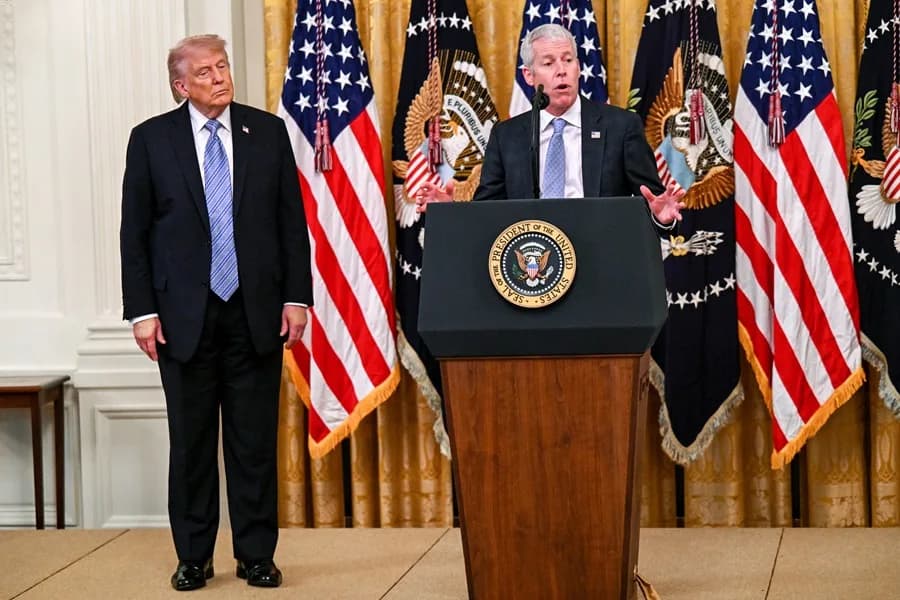
U.S. President Donald Trump made a striking statement this Thursday. He asserted that Secretary of Energy Chris Wright plays a central role in the strategy toward Venezuela. «He is directing Venezuela,» Trump said during an official event. The phrase generated immediate attention when interpreted as a public endorsement of the U.S. official’s management. The president made these remarks during an event held at the headquarters of the Environmental Protection Agency. There he openly praised Wright’s performance within the White House’s new energy policy.
A direct endorsement of Wright’s management
Trump was emphatic in describing the work carried out by his Secretary of Energy. «He is directing better than anyone ever before,» the president added during his public remarks. «I think we can say that Chris Wright is doing a great job. Thank you!» Trump expressed to those present. These words reinforced the message of institutional support toward the official responsible for energy policy. When questioned about the concrete results of U.S. participation in Venezuela, Trump offered a brief response. «We are also winning a lot,» he assured, without offering additional details about the scope of that claim.
Wright leads energy strategy toward Caracas
Trump’s statements come several months after a key trip made by Wright. The Secretary of Energy visited Venezuela on February 11 as part of the new policy promoted by the U.S. administration. That visit came after the relaxation of sanctions on the Venezuelan energy sector. During his stay, Wright held direct meetings with interim president Delcy Rodríguez. The official also toured oil facilities to assess the operational conditions of the local industry. His objective was to analyze specific projects aimed at increasing crude production in the country.
The objective behind the official visit
Wright’s trip sought to promote the recovery of the Venezuelan oil sector in a concrete manner. It also aimed to advance energy cooperation agreements between both countries. Furthermore, the secretary directly reviewed on the ground the capacity of Venezuela’s main oil fields. This assessment proved key to defining the next steps of the U.S. strategy. Just two days after that visit, the Treasury Department issued new licenses that authorized international companies to reactivate operations in Venezuela.
Major oil companies reactivate operations in the country
General licenses 49 and 50 allowed companies such as Chevron, BP, Eni, Shell, and Repsol to resume their activities on Venezuelan soil. All of this under a scheme regulated directly by the U.S. government. Since then, Wright has assumed a relevant role in negotiations with these international oil companies. He also oversees the new Venezuelan oil commercialization model recently implemented. This energy strategy is considered one of the Trump administration’s main economic bets in the Latin American region.
A billion-dollar investment projected for Venezuela
The White House maintains that the recovery of the Venezuelan energy industry could attract considerable investments. It is estimated that they could reach close to 100 billion dollars over the coming years. These investments would be prioritized for U.S. companies interested in expanding their presence in the Venezuelan oil market. The strategy seeks to position the United States as the principal actor in this economic recovery. At the same time, Washington maintains a supervision scheme over the income derived from Venezuelan crude exports.
Financial control combined with economic openness
This strategy seeks to combine economic openness with strict financial control mechanisms. The objective is to guarantee transparency in the management of resources generated by the oil industry. Relations between the United States and Venezuela have also changed significantly following the capture of former president Nicolás Maduro. This event marked a turning point in bilateral policy between both countries. Secretary of State Marco Rubio has explained to Congress the central pillars of this new U.S. strategy toward Venezuela.
Institutional containment and «oil quarantine»
According to Rubio, U.S. policy focuses on the institutional containment of the South American country. It also includes the implementation of what he has called an «oil quarantine» as a control mechanism. Additionally, Washington seeks to promote economic reforms and consolidate a new democratic framework in Venezuela. These elements form an integral part of the current diplomatic strategy between both countries. To this complex panorama is added the additional challenge of national reconstruction after recent earthquakes.
Earthquakes complicate economic recovery
On June 24, Venezuela suffered a series of earthquakes with significant material consequences. This Thursday, the World Bank estimated direct physical damage at 19.6 billion dollars. The international organization warned that slow recovery could significantly affect Venezuelan economic growth in the coming years.
Canal oficial
Únete a nuestro canal de WhatsApp
Recibe las noticias más importantes al instante, sin spam. Solo lo que importa, cuando importa.

Comentarios
Inicia sesión para comentar
Es gratis y toma un minuto. Con tu cuenta también podés:
- Comentar y participar en la conversación
- Guardar notas para leer después
- Ver tu historial de lectura
- Recibir el boletín con tus temas favoritos